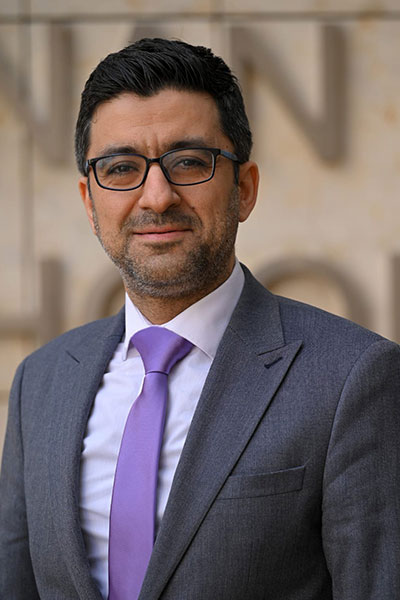
Dr. Ali Fakih
Professor of Economics and Associate Dean of the Adnan Kassar School of Business
afakih@lau.edu.lb
Ext. 1509
AKSOB 1519
LAU Beirut
Biography
Ali Fakih is a professor of economics and the associate dean at the Adnan Kassar School of Business at the Lebanese American University. He is also a fellow at the Economic Research Forum (ERF), IZA Institute of Labor Economics, Centre for Interdisciplinary Research and Analysis of Organizations (CIRANO), and Global Labor Organization (GLO). He previously served as Chairperson of the Department of Economics at LAU from 2022 to 2025. He received his PhD in Economics in 2011 from HEC Montréal, the business school affiliated with l’Université de Montréal. His research interests include Labor Economics, Development Economics, Econometrics, Finance-Growth Nexus, Political Transformations, and MENA Economies. His articles have appeared in international journals such as Journal of Econometrics, Review of Political Economy, Annals of Public and Cooperative Economics, Defence and Peace Economics, Tourism Economics, Journal of Agricultural Economics, International Journal of Manpower, Journal of Industrial Relations, Social Indicators Research, and International Migration, Social Science Quarterly, among others.
Teaching Interests
- Microeconomics
- Managerial Economics
- Introductory Econometrics
- Microeconometrics
- Macroeconometrics
- Labor Economics
- Research Methods in Business
Research Interests
- Labor Economics
- Development Economics
- Applied Econometrics
- Applied Microeconomics
- MENA economies
Selected Publications
- Fakih, A., El-Baba, W., & Fakih, K. (2026). Non-universal social protection systems and labor market outcomes in unstable economies: The case of Lebanon. International Journal of Manpower, 47(1), 134–151.
- Fakih, A., Awdeh, A., & Tchelderian, V. (2025). Sovereign debt and financial sector nexus in the MENA region.International Journal of Islamic and Middle Eastern Finance and Management (forthcoming).
- Fakih, A., & Alamah, Z. (2025). Is the price of Ether driven by demand or pure speculation? Computational Economics, 66, 323–347.
- Fakih, A., Fayyad, D., Debian, A., Neaimeh, A., & Zeaiter, H. (2025). What are the drivers of education attainment in the MENA region? African Development Review, 37(3), 1–23.
- Fakih, A., Tang, C. F., & Abosedra, S. (2025). A cross-country COVID-19 mortality rate: How do institutions make a change? Journal of Health Management, 27(1), 38–46.
- Fakih, A., El Chaar, J., El Arissy, J., & Kassab, S. (2025). Governance quality and the labor market in the MENA region post-Arab Spring. International Journal of Social Economics, 52(3), 422–439.
- Fakih, A., Alamah, Z., & El Gammal, W. (2024). Does Twitter economic uncertainty matter for wheat prices? Economics Letters, 234, 1–6.
- Fakih, A., & Sleiman, Y. (2024). The gender gap in political participation: Evidence from the MENA region. Review of Political Economy, 36(1), 154–177.
- Fakih, A., Lizzaik, Z., & Kassab, S. (2024). Employability of Syrian refugees in Lebanon: The role of legal residency.Defence and Peace Economics, 35(8), 1028–1045.
- Fakih, A., & Diab, A. (2024). Determinants of happiness among Arab youth: Evidence from a youth survey. SAGE Open, 24(1), 1–13.
- Fakih, A., Sayour, N., & Hammoud, M. (2024). Youth voting behavior and institutional change in the post-Arab Spring era. Economic and Political Studies, 12(3), 318–344.
- Fakih, A., Ahmad, I. A., & Hammoud, M. (2023). Perception of parents about children’s mental health during COVID-19: Evidence from Canada. Social Science & Medicine, 337, 1–11.
- Fakih, A., Singh, V. K., Abosedra, S., Ghosh, S., & Kanjilal, K. (2023). Economic volatility and financial deepening in Sub-Saharan Africa: Evidence from panel cointegration with cross-sectional heterogeneity and endogenous structural breaks. Empirical Economics, 65(5), 2013–2038.
- Fakih, A., Baltaji, R., & Sayour, N. (2023). How did COVID-19 lockdowns affect firms and workers? Evidence from Jordan and Morocco. Development Policy Review, 41(6), 1–23.
- Fakih, A., Boutros, P., & Tarraf, M. (2023). Adapting to the new normal: The impact of remote work on firm performance in Jordan and Morocco. Regional Science Policy & Practice, 15(8), 1722–1740.
- Fakih, A., Abosedra, S., Ghosh, S., & Kanjilal, K. (2023). Financial development and business cycle volatility nexus in the UAE: Evidence from non-linear regime-shift and asymmetric tests. International Journal of Finance & Economics, 28(3), 2729–2741.
- Fakih, A., & Boutros, P. (2023). The disability employment paradox in developing countries: Recent evidence from Lebanon. Development Studies Research, 10(1), 1–16.
- Fakih, A., & Elbaba, M. (2023). The willingness to emigrate in six MENA countries: The role of post-revolutionary stress. International Migration, 61(4), 201–220.
- Fakih, A., & El-Baba, W. (2023). COVID-19 and consumer behavior: Assessing food stockpiling behaviors in the US market. Agribusiness, 39(2), 515–534.
- Fakih, A., Arayssi, M., & Haimoun, N. (2023). Skill mismatch, nepotism, job satisfaction, and young females in the MENA region. Econometrics, 11(2), 1–20.
- Fakih, A., & Fakhoury, A. (2023). Government intervention and business response as determinants of business continuity amid COVID-19: The case of Jordan and Morocco. International Journal of Economic Policy in Emerging Economies, 17(2), 196–219.
- Fakih, A., Alamah, Z., & AlSoussy, I. (2023). The role of international research collaboration and faculty-related factors in publication citations: Evidence from Lebanon. Economies, 11(3), 1–24.
- Fakih, A., & Khayat, R. (2022). Social identity, confidence in institutions, and youth: Evidence from the Arab Spring.Social Science Quarterly, 103(5), 997–1018.
- Fakih, A., Sleiman, A., & Haimoun, N. (2022). What drives demand for private tutoring in the MENA region? Evidence from a youth survey. African Development Review, 34(2), 268–279.
- Fakih, A., Makdissi, P., Marrouch, W., Tabri, R., & Yazbek, M. (2022). A stochastic dominance test under survey nonresponse with an application to comparing trust levels in Lebanese public institutions. Journal of Econometrics, 228(1), 205–227.
- Fakih, A., & Ahmad, I. A. (2022). Does the legal form matter for firm performance in the MENA region? Annals of Public and Cooperative Economics, 93(2), 342–358.
- Fakih, A., Tang, C. F., & Abosedra, S. (2022). The fatality rate of COVID-19: How do education, health infrastructure, and institutional quality make a change? Margin: The Journal of Applied Economic Research, 16(2), 166–182.
- Fakih, A., Boutros, P., Lizzaik, Z., & Kassab, S. (2022). Does the number of publications matter for academic promotion in higher education? Evidence from Lebanon. Social Sciences, 11(10), 1–23.
- Fakih, A., & Boutros, P. (2022). Drivers of research outcomes in developing countries: The case of Lebanon. Economies, 10(3), 1–21.
- Fakih, A., Abosedra, S., & Laopodis, N. T. (2021). Dynamics and asymmetries between consumer sentiment and consumption in pre- and during-COVID-19 time: Evidence from the US. Journal of Economic Asymmetries, 24, 1–11.
- Fakih, A., & Sayour, N. (2021). Who prays during crises? Evidence from the COVID-19 pandemic. Empirical Economics Letters, 20(8), 1384–1388.
- Fakih, A., & Ghazalian, P. (2021). Did the Arab Spring lead to economic, institutional, and socio-political changes?International Journal of Social Economics, 48(1), 1658–1676.
- Fakih, A., & Barakat, Z. (2021). Determinants of the Arab Spring protests in Tunisia, Egypt, and Libya: What have we learned? Social Sciences, 10(8), 1–15.
- Fakih, A., Dibeh, G., Marrouch, W., & Matar, G. (2021). Who cares about environmental quality? Evidence amongst youth in the MENA region. Social Indicators Research, 157, 603–629.
- Fakih, A., Ghazalian, P., & Ghazzawi, N. (2020). The effects of power outages on the performance of manufacturing firms in the MENA region. Review of Middle East Economics and Finance, 16(3), 1–28.
- Fakih, A., Haimoun, N., & Kassem, M. (2020). Youth unemployment, gender, and institutions during transition: Evidence from the Arab Spring. Social Indicators Research, 150, 311–336.
- Fakih, A., Dibeh, G., & Marrouch, W. (2020). Tourism-growth nexus under duress: Lebanon during the Syrian crisis.Tourism Economics, 26(3), 353–370.
- Fakih, A., Arayssi, M., & Haimoun, N. (2019). Did the Arab Spring reduce MENA countries’ growth? Applied Economics Letters, 26(19), 1579–1585.
- Fakih, A., Dibeh, G., & Marrouch, W. (2019). Employment and skill mismatch among youth in Lebanon. International Journal of Manpower, 40(8), 1438–1457.
- Fakih, A., Dibeh, G., & Marrouch, W. (2019). Labor market and institutional drivers of youth irregular migration in the MENA region. Journal of Industrial Relations, 61(2), 225–251.
- Fakih, A., Coutts, A., Daoud, A., Marrouch, W., & Reinsberg, B. (2019). Guns and butter? Military expenditure and health spending on the eve of the Arab Spring. Defence and Peace Economics, 30(2), 227–237.
- Fakih, A., & Marrouch, W. (2019). Environmental Kuznets curve: A mirage? A non-parametric analysis from MENA countries. International Advances in Economic Research, 25(1), 113–119.
- Fakih, A., Arayssi, M., & Kassem, M. (2019). Government and financial institutional determinants of development in MENA countries. Emerging Markets Finance and Trade, 55(11), 2473–2496.
- Fakih, A., Dibeh, G., & Marrouch, W. (2018). Decision to emigrate amongst the youth in Lebanon. International Migration, 56(1), 5–22.
- Fakih, A. (2018). What determines vacation leave? The role of gender. Bulletin of Economic Research, 70(1), 1–19.
- Fakih, A., & Arayssi, M. (2017). The finance-growth nexus, again: New evidence from Kenya. Economic Issues, 22(2), 33–59.
- Fakih, A., & Arayssi, M. (2017). Finance-growth nexus in a changing political region: How important was the Arab Spring? Economic Analysis and Policy, 55, 106–123.
- Fakih, A., & Ghazalian, P. (2017). R&D and innovation in food processing firms in transition countries. Journal of Agricultural Economics, 68(2), 427–450.
- Fakih, A., & Abosedra, S. (2017). Assessing the role of financial deepening and remittances in growth: The experience of Lebanon. Global Economy Journal, 17(1), 1–17.
- Fakih, A., & Dah, A. (2016). Decomposing the gender wage differentials using quantile regression: Evidence from the Lebanese banking sector. International Advances in Economic Research, 22(2), 171–185.
- Fakih, A., & Ibrahim, M. (2016). The impact of Syrian refugees on the labor market in neighboring countries: Evidence from Jordan. Defence and Peace Economics, 27(1), 64–86.
- Fakih, A., & Ghazalian, P. (2015). What factors influence firm perceptions of labour market constraints to growth in the MENA region? International Journal of Manpower, 36(8), 1181–1206.
- Fakih, A., & Marrouch, W. (2015). The electricity consumption, employment, and growth nexus: Evidence from Lebanon. OPEC Energy Review, 39(3), 298–321.
- Fakih, A., & Arayssi, M. (2015). Institutions and development in the MENA region: Evidence from the manufacturing sector. International Journal of Social Economics, 42(8), 717–732.
- Fakih, A., & Ghazalian, P. (2015). Female employment in MENA’s manufacturing sector: The implications of firm-related and national factors. Economic Change and Restructuring, 48(1), 37–69.
- Fakih, A. (2014). Vacation leave, work hours, and wages: New evidence from linked employer-employee data. LABOUR, 28(4), 376–398.
- Fakih, A., & Ghazalian, P. (2014). Which firms export? An empirical analysis for the manufacturing sector in the MENA region. Journal of Economic Studies, 41(5), 672–695.
- Fakih, A., & Abosedra, S. (2014). The relationships between economic growth, financial deepening, and information and communication technology: Empirical evidence from Lebanon. Journal of Economic Research, 19(1), 1–17.
- Fakih, A., & Marrouch, W. (2014). Who hires foreign domestic workers? Evidence from Lebanon. Journal of Developing Areas, 48(3), 339–352.
Policy Work
- Fakih, A. (2026). Closing the gender gap in political participation in MENA. The Forum, Economic Research Forum.
- Fakih, A. (2025). Sectoral investment strategies for job creation and female employment in Lebanon: An input-output analytical approach. UN Women.
- Fakih, A. (2025). Empowering Arab women through wage equality: A comprehensive study on equal pay for work of equal value. United Nations Economic and Social Commission for West Asia.
- Fakih, A. (2025). The burden of corruption: How systemic exploitation marginalizes vulnerable communities in Lebanon.Transparency International.
- Fakih, A. (2025). Cost-benefit analysis of the legal aid helpdesks project in Lebanon (forthcoming). United Nations Development Programme.
- Fakih, A. (2024). The impact of trade and investment policies on productive and decent work: Country report on Lebanon(forthcoming). International Labour Organization.
- Fakih, A. (2024). Livelihoods in Sudan amid armed conflict: Evidence from a national rural household survey. United Nations Development Programme.
- Fakih, A. (2022). Women’s economic participation in Lebanon: A mapping analysis of laws and regulations. United Nations Economic and Social Commission for West Asia.
- Fakih, A., & Brun, C. (2022). Debunking the myth of the economic burden of refugees [Op-ed]. The New Humanitarian.
- Fakih, A., & ElBaba, W. (2022). Economy of Lebanon. In The Middle East and North Africa. Routledge.
- Fakih, A., & Boutros, P. (2022). Economy of Jordan. In The Middle East and North Africa. Routledge.
- Fakih, A., & Tarraf, M. (2022). Economy of Syria. In The Middle East and North Africa. Routledge.
- Fakih, A., Brun, C., Shuayb, M., & Hammoud, M. (2021). The economic impact of the Syrian refugee crisis in Lebanon: What it means for current policies. World Refugee & Migration Council, Georgetown University.
- Fakih, A. (2021). The provision of family-friendly work practices in Lebanon: Challenges and consequences for the private sector. Arab Institute for Women.
- Fakih, A. (2021). The effect of family-friendly work practices on firm productivity in Lebanon: Evidence from parental leave and childcare provision. Arab Institute for Women.
- Fakih, A., & Hammoud, M. (2021). Economy of Lebanon. In The Middle East and North Africa. Routledge.
- Fakih, A., & Ahmad, I. A. (2021). Economy of Jordan. In The Middle East and North Africa. Routledge.
- Fakih, A., & Hammoud, M. (2021). Economy of Syria. In The Middle East and North Africa. Routledge.
- Fakih, A., Haimoun, N., & Abosedra, S. (2020). Power-sharing, ethnic divisions and the onset of civil wars in Syria. The Forum, Economic Research Forum.
- Fakih, A., & Hammoud, M. (2020). Economy of Jordan. In The Middle East and North Africa. Routledge.
- Fakih, A., & Haimoun, N. (2020). Economy of Syria. In The Middle East and North Africa. Routledge.
- Fakih, A., & Araji, S. (2019). Employment profile and challenges of the private sector in Iraq. United Nations Economic and Social Commission for West Asia.
- Fakih, A., & Haimoun, N. (2019). Economy of Jordan. In The Middle East and North Africa. Routledge.
- Fakih, A., Dibeh, G., & Marrouch, W. (2016). The poor and marginalized in Lebanon: Labor market challenges and policy implications (SAHWA Policy Paper No. 1). Barcelona Centre for International Affairs.
- Fakih, A., & Marrouch, W. (2015). The economic impacts of Syrian refugees: Challenges and opportunities in host countries. Georgetown Journal of International Affairs.
- Fakih, A., & Arayssi, M. (2015). Why does institutional development matter for MENA’s manufacturing sector? Policy paper (Menapolis project).
- Fakih, A. (2015). Energy poverty. United Nations Development Programme, Arab Development Portal.
- Fakih, A. (2015). Energy subsidies. United Nations Development Programme, Arab Development Portal.
- Fakih, A. (2014). Vacation leave, work hours and wages: New evidence from linked employer-employee data. Centre for Interdisciplinary Research and Analysis on Organizations (Note No. 1).
- Fakih, A., & Marrouch, W. (2014). Who hires foreign domestic workers? Evidence from Lebanon. NEP-ARA Blog.