From Vision to Action: Women Redefining Entrepreneurship in Lebanon
Women founders and community leaders shared how resilience, purpose and collective support are transforming businesses into forces for social and economic change.
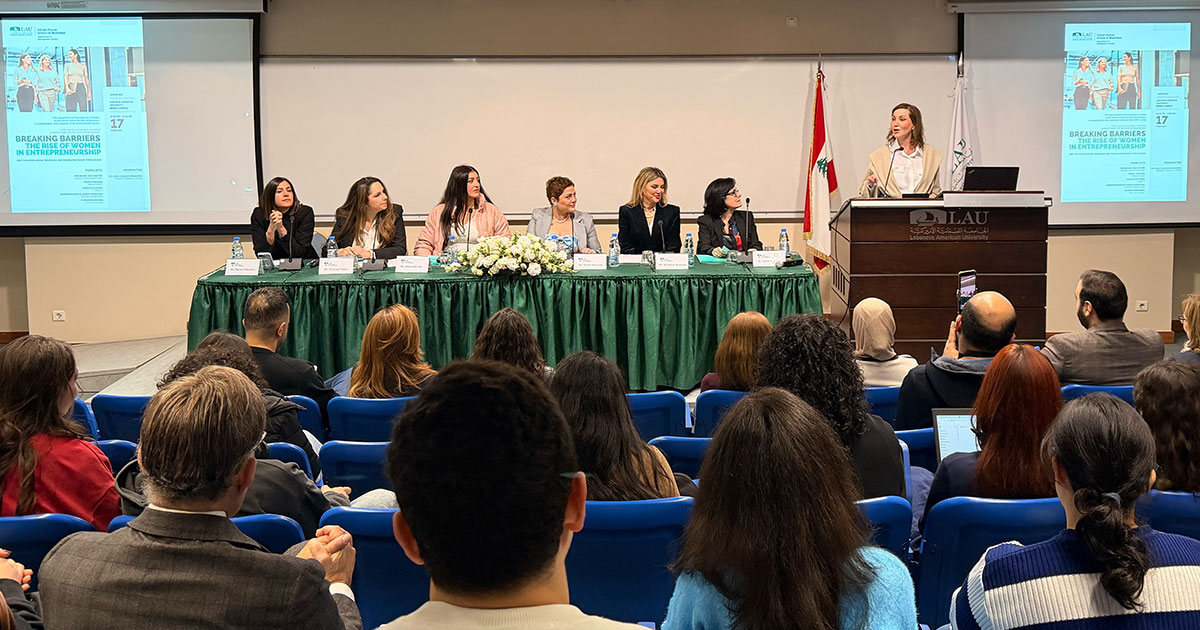
On February 17, the Department of Management Studies at the Adnan Kassar School of Business (AKSOB), in collaboration with Lebanon HUB and the HOPE Center, brought together students, faculty and community partners at the LAU Beirut campus to explore how women founders are building resilient ventures in Lebanon and reshaping the entrepreneurial landscape through courage, community and conviction.
The panel, titled Breaking Barriers: The Rise of Women in Entrepreneurship and moderated by Dr. Leila Canaan Messarra, associate professor of management at AKSOB, unfolded not as a celebration of polished success stories but as an honest reflection on beginnings. Together, the speakers’ accounts revealed what it means to contribute directly to local economic recovery.
The panel featured Micheline Abu Khater, Hope Center women empowerment community coordinator, Maria Chaghid of Majestic Events, Chantale Fahed of Savon.J, Dareen Roukoz and Samah Hamouda of Dar Sam Styling House and Myriam Massarra of Mimi et ses petits. Their sectors ranged from sustainable fashion and organic soap making to event planning and child care. Yet their impact extended beyond products and services. Each woman described entrepreneurship as an act of agency.
Abu Khater positioned women’s entrepreneurship as both an economic necessity and a cultural shift. In a country strained by financial crisis and social pressures, economic autonomy is closely tied to dignity and participation, she said. When a woman launches a business, she does more than generate income; she establishes decision-making power within her household and community. “Your own enterprise becomes your voice and visibility,” she noted, underscoring the impact this has on other women and families.
At the HOPE Center, this conviction has translated into tangible support systems. Women are guided through business planning, connected to mentors and introduced to market opportunities that turn ideas into functioning enterprises. What begins as individual initiative grows into collective momentum. Products spread, services expand, and revenue moves through local communities. Entrepreneurship becomes an economic network rather than a solitary effort.
Across sectors, the women demonstrated that resilience is not a slogan but a practice. Samah Hamouda, founder and owner of Dar Sam Styling House, explained that being resilient in times of crisis requires an operational strategy to ensure social contribution. For her, “redesigning second-hand clothing while supporting families in need turned resilience into action,” she said.
Similarly, Chantale Fahed noted that “Obstacles and financial strains are part of starting a business; they pave the way to what is coming next.”
The owner of Savon. J, a natural soap brand grounded in environmental responsibility and local production, began in a small Lebanese village in response to skin sensitivities caused by commercial products. Guided by traditional knowledge and modern training, she transformed a household remedy into a growing line of natural soaps, fueled by a need to create opportunities and make a difference.
Maria Chaghid, owner of Majestic Events, found inspiration in this shared drive to achieve as a woman entrepreneur. “Brand-building creates both emotional and economic value,” she noted. Chaghid highlighted two key elements for business success: “Passion and credibility,” especially in a market saturated with social media visibility. She pointed out that differentiation lies in sustainable growth and the willingness to evolve.
In early childhood education, Myriam Massarra founded Mimi et ses petits at 24, stepping into a sector where authority is often measured by age rather than expertise. She encountered doubt alongside opportunity. “Working with families requires emotional resilience as much as academic preparation,” said Massarra. With this mindset, she expanded her nursery into a growing platform that now includes a cultural center and a parenting podcast.
Throughout all the shared stories, one theme emerged repeatedly: None of these women began with certainty, but with commitment. Their businesses create employment, promote sustainability, educate families and challenge social assumptions about leadership.
The message resonated clearly at the end of the discussion. Entrepreneurship grows in difficult and uncertain conditions. And when women lead with purpose, their impact extends beyond profit to possibility, inspiring others to imagine what they, too, might build and become.