LAU’s Executive MBA Brings the Boardroom Into the Classroom with Alain Bejjani
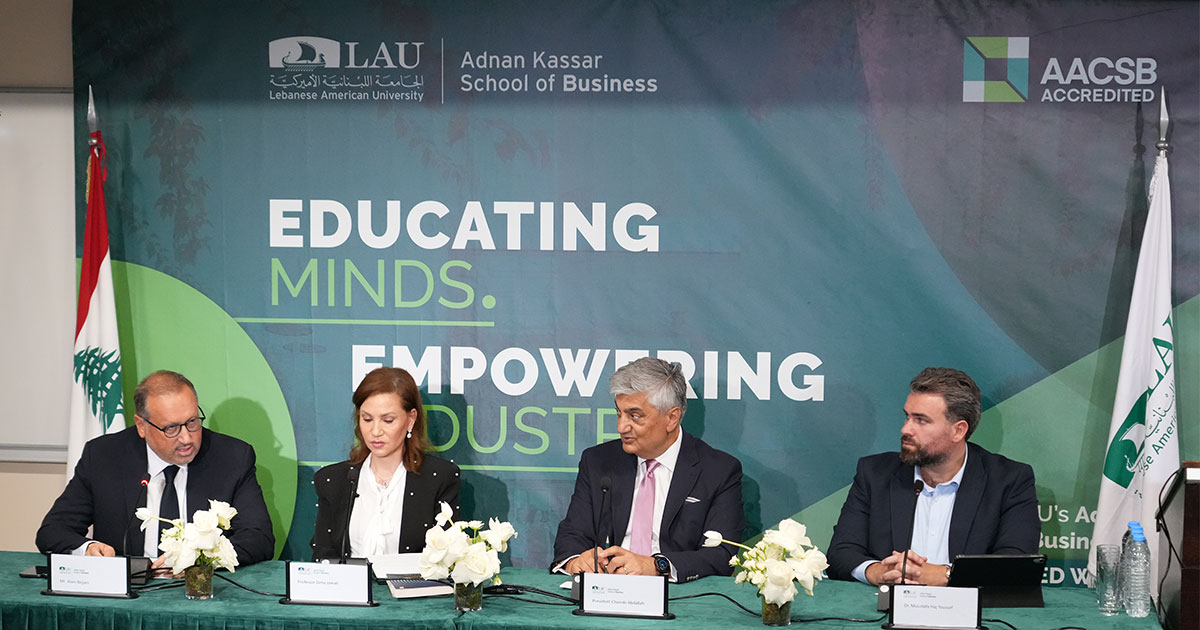
Through its Executive in Residence model, the program at the Adnan Kassar School of Business brings accomplished business leaders closer to participants and the complex decisions they face.
What does an executive with decades of experience need from a classroom?Increasingly, the answer goes beyond frameworks and theory to the judgment that comes from making consequential decisions in the real world.
That idea took center stage on September 11 at the LAU Beirut campus, where the Adnan Kassar School of Business (AKSOB) welcomed Alain Bejjani as Executive in Residence for its Executive Master of Business Administration Program (EMBA) for the 2026–27 academic year.
LAU leaders, students, alumni, faculty, and industry professionals joined the conversation on how executive education can respond to increasingly complex leadership realities.
For a program that pioneered executive education in Lebanon and the region 25 years ago, bringing accomplished business leaders into the learning experience is part of its continued evolution. Their participation gives learners access to executive expertise and the judgment developed through leading organizations, navigating uncertainty, and making decisions when no obvious answers exist.
LAU President Chaouki T. Abdallah underscored the value of that exchange.
“Effective leadership requires sound judgment,” he said. “This is precisely the value of the Executive in Residence model. It brings real-world leadership experience into the academic environment, creating opportunities for our Executive MBA participants to connect theory with practice.”
That connection is particularly relevant to a program whose students are seasoned professionals. For AKSOB Dean Dima Jamali, their experience calls for an education that goes beyond conventional approaches.
“The people sitting in our classrooms are running organizations in circumstances that no textbook was written for,” she said. “They are not short on frameworks. What they need is judgment, and judgment is hard to teach from slides.”
Bejjani’s honorary appointment is designed as an ongoing engagement rather than a guest appearance. He will work with Executive MBA cohorts at key junctions of their studies, from the onset of the program through their capstone projects, and participate in residencies, giving them sustained access to his perspective and experience.
“What they will get from me is the unpolished truth that they are facing outside and how they will deal with it,” he said. “That is what I call bringing the boardroom into the classroom.”
The conversation then turned to the leadership challenges that executives face in uncertain environments, including the distinction between resilience and adaptability, withstanding disruptions, and changing the course when circumstances demand it. The discussion also addressed judgment, employability, technological change, and the growing complexity of executive decision-making.
The event concluded with an interactive Q&A, where Bejjani fielded students’ questions on leadership. For Bejjani, that exchange is an important part of what he hopes to bring to the Executive MBA experience.