Inside the Metaverse Classroom: How LAU Students Turned Crisis into Strategy
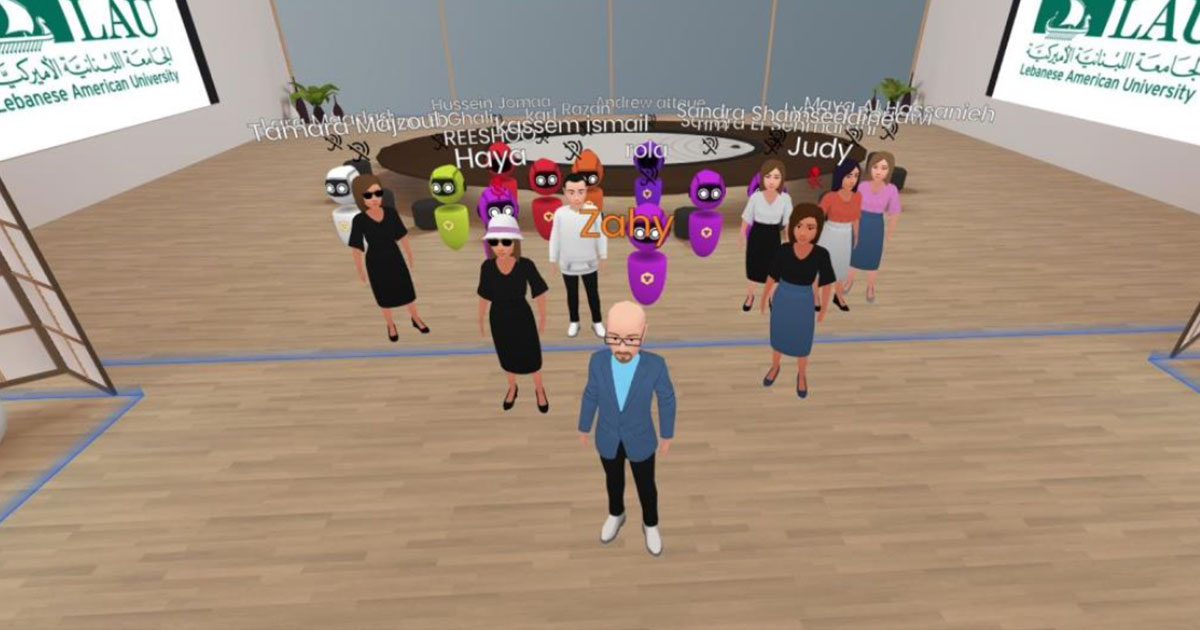
A live, immersive case study pushed marketing students to think, decide and adapt in real time.
Between March and April 2026, senior students in the Marketing Strategy course (MKT498) at LAU found themselves logging into something entirely different from a traditional class.
Instead of going into a regular session, they entered a metaverse environment, designed as a live, multi-stage case study to mirror the kind of ambiguity they were already living through, and were asked to make sense of it.
The initiative, designed and led by Zahy Ramadan, associate professor of marketing at the Adnan Kassar School and director of the Internal Consulting and Project Management (ICPM) Office, was not just about keeping the course running. It was about changing how students experience strategy when the context itself is unstable.
“Students created avatars and stepped into a live case, engaging with multiple GenAI non-player character (NPCs) stakeholders to ask questions, seek out information and decide what mattered in defining marketing strategies,” explained Dr. Ramadan.
“It felt like we were part of the situation, not just studying it,” said Maya Al Hassanieh. “We were not flipping pages. We were interacting, questioning and making decisions throughout the process. It made learning more engaging but also more meaningful.”
That shift changed the pace of the virtual classroom. Students moved quickly from observation to action. Conversations replaced note-taking. Questions became the main tool for understanding. They leaned into the uncertainty, testing ideas and adjusting as they went.
The project unfolded over three stages, each adding a new layer of pressure. In the first, students interacted with NPCs representing different stakeholders. Each conversation revealed only part of the picture. To move forward, students had to connect the dots themselves.
“We had to think about what to ask,” explained Abdo Okaybi. “This interaction helped me improve my prompts to personalize my learning experience and better understand the connection between marketing strategy and emerging digital trends,” he added.
As they moved into the Strategy Gallery, the dynamic shifted. Screens filled with competing ideas, campaign directions and interpretations of the same situation. Students walked through each other’s work, paused, questioned and sometimes reconsidered their own.
“Seeing how other teams approached the case study made me realize how differently people can interpret the same challenge,” said Judy Dbouk. “Balancing the perspectives of customers and retailers pushed us to think more carefully about our decisions.”
“The final stage raised the stakes,” said Dr. Ramadan. “Students were asked to defend their strategies to a simulated headquarters representative,” he added.
The conversation was live, and the pushback was immediate. Plans that seemed solid minutes earlier were questioned, challenged and, in some cases, dismantled.
“We chatted live with the AI avatar, which brought a different energy to the learning experience,” said Yasmina Fawaz. “It helped turn abstract concepts into something more tangible and engaging,” she explained.
That tension, between confidence and flexibility, became the core of the experience. Students were no longer trying to get the “right” answer. They were learning how to explain their thinking, adjust under pressure and keep moving forward even when things did not align.
“The feedback reflected more than improvement,” said Dr. Ramadan. “It showed a shift in how students think, more confident with AI, more creative in their approach and more connected to the experience itself.”
By placing students in a setting that reflected instability while equipping them to navigate it, the course created a space where learning felt both relevant and immediate.
At its core, the Live Metaverse Case Study was less about technology and more about mindset. It asked students to stay engaged when answers were not clear, to listen more carefully and to build arguments they could stand behind.
“Through the Live Metaverse Case Study, the Department of Marketing at AKSOB wanted to move beyond passive case discussions and create something more immersive and practice-driven,” said Dr. Ramadan. “The goal was to help students think through uncertainty, ask better questions and navigate different perspectives while staying engaged despite a very difficult context.”