Rethinking Skills in the Age of AI
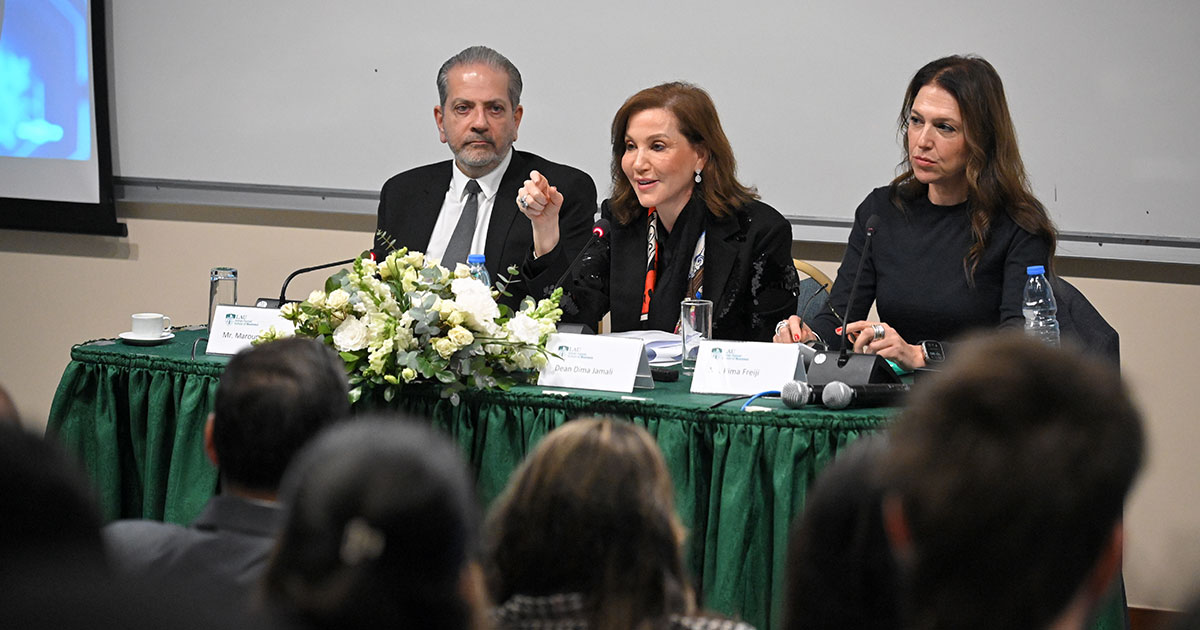
Leaders from industry and academia gathered at LAU to explore how artificial intelligence and a skills-first approach are reshaping employability.
In a labor market shaped by rapid technological change and growing uncertainty, relevance has become a moving target for graduates and employers alike.
Business leaders and academics convened at the LAU Beirut campus on February 12, 2026, to examine how careers are changing and what higher education must do to keep pace.
The talk, titled The Skills of the Future, organized by the Institute of Human Resources Management at LAU’s Adnan Kassar School of Business (AKSOB) and moderated by Dean Dima Jamali, featured Maroun Chammas, vice chairman and general manager of Medco and chairman and CEO of Berytech, and Rima Freiji, president of the Lebanese Private Sector Network and chairperson of Tanmia.
The discussion shifted between industry challenges and educational goals, demonstrating how artificial intelligence (AI) is transforming jobs and reshaping learning models and career pathways.
Speakers focused on a paradox defining today’s labor market: Persistent unemployment alongside an increasingly acute skills gap. From an industry standpoint, Freiji pointed out that, whether in product development, food technology, or even AI incorporation in agriculture, the talent pool graduating with the skills needed for the food sector is limited, and companies struggle to recruit qualified talent. “This mismatch,” she said, “makes skills alignment an urgent economic priority, not just a slogan.”
Freiji assured that AI is designed to enhance human capability, not replace it, and that universities must move from knowledge accumulation to relevance. “Today’s workplace demands data literacy and analytical rigor,” she added, “along with the ability to apply knowledge responsibly in real-world settings.”
Dr. Jamali echoed this view, reminding students that AKSOB has refocused its vision and priorities on AI, entrepreneurship, innovation and sustainability. She encouraged them to actively pursue workshops, competitions and experiential learning opportunities, noting that AI is a tool that, when used responsibly, can improve human productivity.
Chammas redirected the discussion toward “the mindset.” Lebanon, he argued, is not short on ability, but endurance. “The talents are there,” he remarked. “The problem is that they do not maximize talent. They scratch the surface and stop.” Drawing a comparison to elite athletics, he observed that natural ability rarely translates into global achievement without discipline, sustained investment and long-term commitment.
The students’ questions reflected both ambition and anxiety, particularly around early-career prospects and compensation. Chammas responded that they would need at least five or six years before they can negotiate their salary, provided they have the talent. The real challenge, he added, was differentiation, reminding them that long-term value is built through performance, consistency and reputation rather than immediate reward.
Throughout the discussion, one principle repeatedly emerged: Employability is a shared responsibility. Universities must align programs with market realities, and policymakers must cultivate supportive ecosystems. However, students should also assume ownership of their development.
Artificial intelligence is transforming industries, compressing career ladders and redefining expectations. In this environment, adaptability, applied skills and disciplined ambition will distinguish those who thrive.
The Skills of the Future will not belong to those who accumulate credentials, but to those who commit to continuous learning and sustained excellence.