LAU’s AKSOB Brings Leaders Together to Address Lebanon’s Financial Crisis
Experts called for transparent, inclusive reforms and collective accountability as key to restoring confidence in Lebanon’s banking system.
The mood at LAU’s Beirut campus on November 5 was one of cautious optimism. Inside the hall, economists, bankers and policymakers gathered to tackle one of Lebanon’s most pressing challenges—the ongoing financial crisis and its profound impact on depositors.
Hosted by the Institute of Banking and Finance at the Adnan Kassar School of Business (AKSOB), the panel titled Financial Crisis: Banking Reality, Reform and Investment Prospects delved into the Lebanese financial crisis and its impact on depositors.
The event brought together seasoned practitioners, students and faculty to confront hard questions about trust, reform and the future of Lebanon’s banking system.
Opening the session, LAU President Chaouki T. Abdallah set an inspiring tone for the evening, noting, “Lebanon has no shortage of ideas—what we need now is the collective will to move from plans to action. Think big, start small, and move fast.” His words captured both the urgency and optimism that guided the conversation.
Dima R. Jamali, dean of AKSOB, built on that momentum with a message of determination and purpose. “We are here to ask tough questions and share forward-looking solutions,” she said. “We aim to reimagine a financial system built on transparency, inclusion and resilience for the communities we serve.”
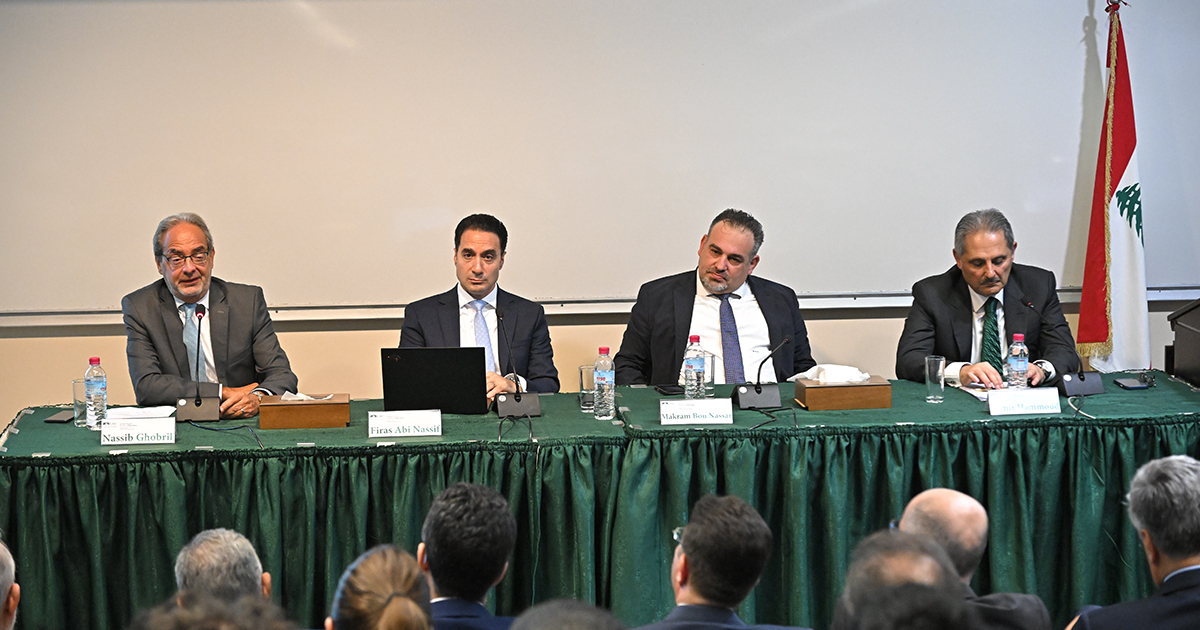
Moderated by Hisham Tabsh, senior instructor of practice at LAU, the panel featured Firas Abi Nassif, LAU trustee and chairman of the board and co-founder of Teleios Capital Partners; Dr. Makram Bou Nassar, vice governor of Banque du Liban; Samir Hammoud, advisor to the minister of finance and former chairman of the Banking Control Commission of Lebanon; and Nassib Ghobril, chief economist at Byblos Bank. Together, they unpacked the causes and consequences of a crisis that continues to shape the nation’s economy.
The speakers outlined the crisis as the outcome of long-standing fiscal imbalances, deep losses in state-owned enterprises—particularly the electricity sector—and repeated political stalemates that weakened investor confidence. Excessive exposure to sovereign and central-bank risk, combined with the absence of formal capital controls, turned a liquidity issue into a full-scale collapse of trust.
Despite differing perspectives, the discussion converged on a common understanding of the path forward: Lebanon’s recovery depends on credible governance, consistent reform and a renewed sense of fairness between institutions and citizens.
From the regulator’s perspective, Hammoud underscored the importance of fairness and legality. “Resolution must weigh four legitimate interests—depositors, banks, the central bank and the treasury—under one principle: The rule of law,” he said. He called for a modern bank-resolution law, a transparent treatment of anomalies and financial instruments that can actually trade in the market. “Justice has to be actionable,” he added, stressing that reform must balance moral integrity with practical feasibility.
From the central bank, Dr. Bou Nassar emphasized that restoring confidence requires clarity and fairness toward depositors. “What matters now is a fair, straightforward approach that treats people equitably and recognizes real savings,” he said. “With a balanced plan, we can rebuild trust, protect all depositors and help the system serve the public again.” He noted that cooperation between the central bank and the Ministry of Finance is essential to creating sustainable solutions.
From an economic standpoint, Ghobril urged a closer examination of the crisis’s roots. “We cannot fix what we refuse to diagnose,” he said. “The problem is not merely technical; governance failures eroded confidence and delayed reform.” He emphasized that judicial independence, fiscal transparency and an agreement with the International Monetary Fund (IMF) are essential steps toward recovery. “Ultimately, it is sustained determination, not short-term engineering, that will drive success,” he concluded.
Bringing in the investor’s perspective, Abi Nassif observed, “Capital does not flee risk; it flees uncertainty and dysfunction.” He noted that Lebanon’s core strengths—its talent, entrepreneurial drive and global diaspora networks—remain underused assets, leaving the country operating well below its productive potential. Predictability and consistency in policy, he argued, would allow these strengths to re-emerge, be fully harnessed and translated into investable opportunities. “Reduce volatility in rules and execution, and capital will follow,” he said, pointing to sectors such as asset-light technology, specialized tourism and the creative industries as early catalysts for renewal.
A clear roadmap emerged from the discussion: pass a modern bank-resolution law that protects depositors while differentiating among banks; establish formal capital controls and transparent fiscal data; revitalize capital markets; and restructure public utilities to stem chronic losses. The speakers agreed that such reforms, though complex, are indispensable to rebuilding trust and restoring economic normalcy.
The session concluded with an engaging exchange between panelists and audience members, underscoring LAU’s commitment to dialogue and collaboration. It also marked the relaunch of the Institute of Banking and Finance, highlighted by the introduction of its newly appointed advisory board. Institute Director Hisham Tabsh announced the council members—Dr. Fadi Osseiran, Dr. Marwan Barakat, Nassib Ghobril, Hadi Hammoud, Rabih Nehme and Mohammad Ali Hassan—reflecting AKSOB’s and LAU’s shared mission to strengthen the institute’s role in fostering informed dialogue, bridging academia and industry and empowering future leaders to drive Lebanon’s sustainable recovery.