Beirut Economics Research Seminar Series Fosters Cross-Institutional Dialogue on Frontier Research
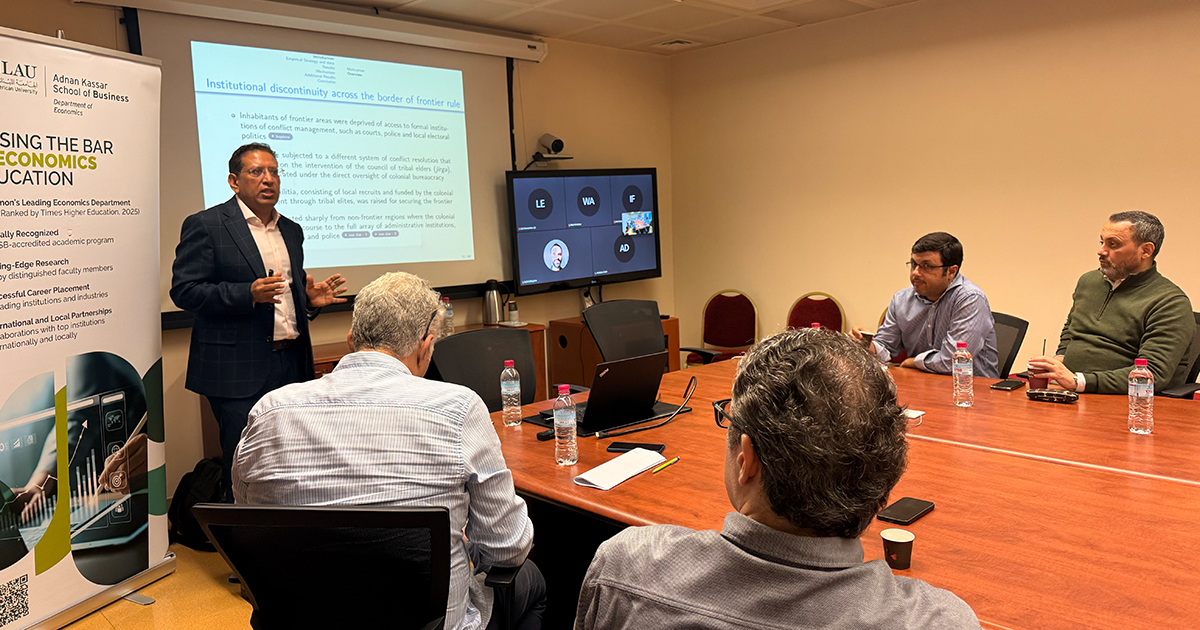
An inter-university seminar series between LAU and AUB explored the latest economics research and sparked critical discussions.
Building on a sustained academic collaboration, LAU continues to play a central role in advancing economic research dialogue in Lebanon.
In spring 2025, the university launched the Beirut Economics Research Seminar Series, co-organized by the LAU Department of Economics and the American University of Beirut (AUB) Department of Economics, bringing together economists from Lebanon and abroad for scholarly exchange. The series’ most recent cycle concluded in November 2025 with a spring 2026 edition already on the horizon.
Structured as a biweekly seminar during the academic year and alternating between the LAU and AUB campuses, the series offered an inclusive platform for economics faculty members, researchers, students, and professionals to engage with frontier economics research. Each session was designed to stimulate dialogue, challenge assumptions, and promote cross-institutional collaboration, reflecting LAU’s commitment to nurturing spaces where rigorous economic inquiry thrives.
The seminar series explored a range of frontier economic themes, including the interaction between markets and regulation, governance and institutional effectiveness, and changing work models and global labor dynamics, in a bid to provide valuable insights for addressing economic challenges.
The spring 2025 cycle opened at LAU’s Adnan Kassar School of Business (AKSOB). Dr. Walid Marrouch, professor of economics and associate dean of Graduate Studies and Research at LAU shared the findings of his study on “Emissions Taxes and Market Power: Linked vs. Unlinked Market Failures.” He explored the intersection of environmental policy and market dynamics, highlighting how addressing market failures in pollution and power can inform tax design to achieve sustainable outcomes. His presentation emphasized evidence-driven policy analysis and encouraged robust discussion among participants.
As the series moved to AUB later in September, Dr. Zeeshan Samad, assistant professor of economics at AUB, shared his research and presented experimental evidence on the “Impact of H-1B Visa Policies.” He showed how visa fees and minimum wage rules for foreign workers affect labor markets and productivity. His findings highlighted that such policies can reduce earnings for both domestic and foreign employees and lower overall productivity. By stressing how policy design choices ripple through labor markets, the session reinforced the seminar’s role as a forum for data-driven economic discussion.
Upon returning to LAU in early October, Dr. Mohamed El-Komi, an associate professor at the American University in Cairo, delivered a talk titled “Designing and Applying Behavioral Interventions for Climate Change in Greater Cairo.” Drawing on insights from the Behavioral and Economic Decision-Making Lab (BEDMLab), he showcased behavioral and economic interventions addressing air quality, waste management, and sustainable mobility. His presentation illustrated how rigorous research can translate into real-world impact, highlighting the power of behavioral economics to inspire practical solutions to pressing environmental challenges.
Later in October at AUB, Tom Kirchmaier, director of policing and crime at the Center for Economic Performance at the London School of Economics, offered a timely exploration of contemporary work models in “Not Incentivized Yet Efficient: Working from Home in the Public Sector,” demonstrating the series’ commitment to addressing both theoretical and applied economic questions.
The November seminars continued to deepen the conversation on governance and global economic dynamics. On November 5, LAU hosted Dr. Adeel Malik, associate professor at the University of Oxford. He presented his research on “Frontier Rule and Conflict,” which examined how governance across contested borders influences development outcomes. His research linked institutional arrangements to patterns of conflict and economic performance, generating lively engagement from students, faculty, and visiting researchers. The fall 2025 series concluded on November 19, 2025, at AUB with Dr. Kamil Yilmaz, professor of economics at Koç University, addressing “Global Inflation Spillovers.”
In all, the sessions demonstrated the need for better policy design, strengthening institutional governance, and promoting sustainable and productivity-enhancing practices as effective reforms toward building long-term economic resilience.